

China Top Mesh Sieves Manufacturers and Suppliers?
China’s manufacturing base has become important for buyers sourcing Mesh Sieves. Demand spans food processing, pharmaceuticals, chemicals, mining, and laboratory testing. MarketsandMarkets’ Screening Equipment Market report identifies mining, construction, and industrial processing as major demand sectors. Its findings suggest that screening performance increasingly depends on durability, automation, and application-specific design.
For procurement teams, supplier comparison should go beyond price. ASTM E11-24 and ISO 3310-1 define requirements for test sieve dimensions, mesh openings, and inspection methods. These standards create a practical reference for checking Chinese manufacturers. A reliable factory should explain wire material, aperture tolerance, frame construction, welding quality, and inspection records. Ask for sample reports. Examine the mesh under magnification. A loose wire or uneven tension can change laboratory results.
Quality expert W. Edwards Deming stated, “Quality comes not from inspection, but from the improvement of the production process.” This principle applies directly to Mesh Sieves. Strong suppliers control wire drawing, weaving, framing, cleaning, and final verification. Some factories provide calibration certificates, material certificates, and batch traceability. Others offer attractive prices but limited technical evidence. That difference matters.
This guide evaluates China’s top Mesh Sieves manufacturers and suppliers through manufacturing experience, technical capability, certification, customization, and export reliability. It also considers response speed and packaging details. A damaged rim can ruin an otherwise accurate sieve. No supplier ranking is perfect. Buyer requirements differ, and published information can become outdated. Independent samples and third-party verification remain wise before large orders.
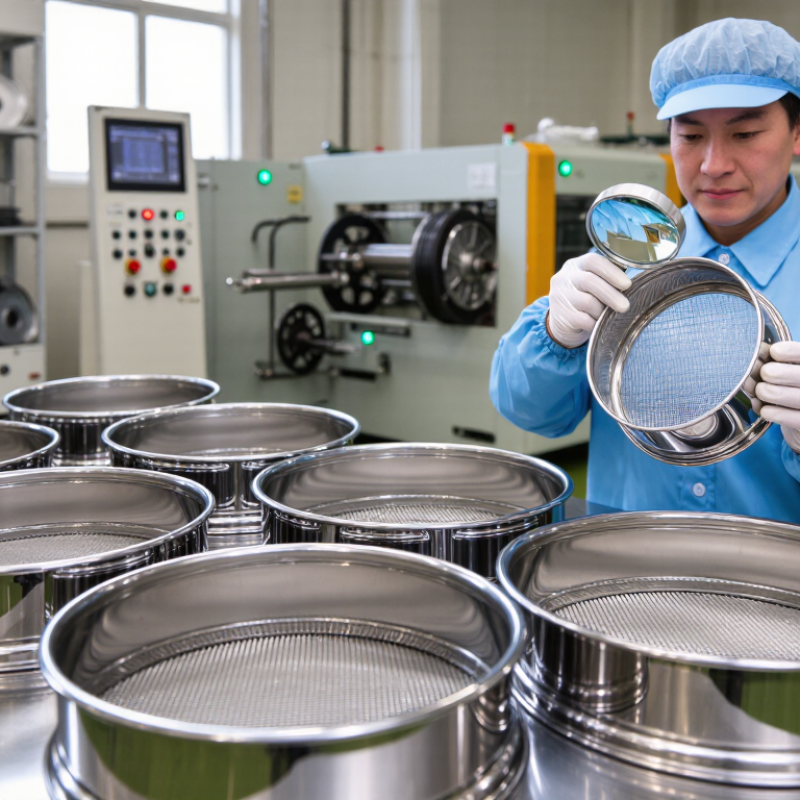
What Are Mesh Sieves and Where Are They Used?
Mesh sieves separate particles by size through a woven or perforated screen. They are simple tools. Their accuracy depends on aperture size, wire shape, sample preparation, and operator technique. A 75-micrometre sieve can remove fine powder, while a 2-millimetre sieve handles larger granules. Stainless steel is common because it resists corrosion and repeated washing. However, even strong steel can distort under rough handling.
Laboratories use mesh sieves to test cement, soil, minerals, pharmaceutical powders, and food ingredients. Construction laboratories often measure aggregate grading before concrete production. The USGS Mineral Commodity Summaries 2024 reported about 1.5 billion metric tons of crushed stone produced in the United States during 2023. That volume shows why consistent particle classification matters. Food processors also screen flour, grains, spices, and sugar. FAO data placed global cereal production near 2.8 billion tonnes in 2023, creating a vast need for reliable size control.
In practice, suppliers should provide certified mesh dimensions, inspection records, and traceable materials. ISO 3310-1 offers a widely used reference for test sieves. Yet certification alone does not guarantee perfect results. Moist samples may clog openings. Vibrations may also change separation efficiency. Users should inspect tension, cleanliness, and aperture damage before each test. Supplier comparisons should examine these details, not only price.
How to Evaluate Chinese Mesh Sieve Manufacturers
When evaluating Chinese mesh sieve manufacturers, begin with production evidence, not polished catalogs. Request ISO 3310-1 or ASTM E11 inspection records for each aperture range. These standards define mesh opening tolerances, wire diameter, and sieve-frame requirements. A reliable factory should show calibration dates, measuring equipment, and sample results.
Industry data also deserves attention. The United Nations Comtrade database records China as a major exporter of woven metal products, but export volume alone cannot prove sieve quality. Ask for three recent batch reports. Check aperture variation under a microscope, frame flatness with a steel ruler, and weld uniformity around the rim. In practice, a 200-mesh sieve may look perfect while holding uneven openings. Small defects matter.
Audits should include material traceability. Confirm stainless-steel grade through mill certificates or third-party composition testing. Request documented tests for corrosion resistance, ultrasonic cleaning, and repeated-use stability. The ASTM E11 framework is useful when comparing inspection methods across suppliers. However, certificates can be incomplete or outdated. I would inspect the production line, not only the showroom. One overlooked issue is packaging: loose sieves can suffer dents during overseas transport, especially at the frame edge. Ask for drop-test evidence and photos from actual shipments. A trial order remains necessary, even after a convincing audit.
China Top Mesh Sieves Manufacturers and Suppliers? - How to Evaluate Chinese Mesh Sieve Manufacturers
| Evaluation Dimension | Reliable Technical Reference | Typical Requirements or Data to Check | Recommended Verification Method | Why It Matters |
|---|---|---|---|---|
| Mesh Classification | Mesh count and aperture size are different measurements. A higher mesh count does not always mean a directly proportional aperture size. | Mesh count Aperture size in mm or μm Wire diameter | Request a technical drawing and confirm the nominal aperture, wire diameter, mesh count, and allowable tolerances. | Prevents incorrect particle-size separation caused by using mesh count alone. |
| Applicable Sieve Standards | Common international references include ISO 3310-1 for test sieves with metal woven mesh, ASTM E11 for wire-cloth test sieves, and EN 933-2 for aggregate testing sieves. | ISO 3310-1 ASTM E11 EN 933-2 | Ask which standard is applied to mesh aperture, inspection, frame dimensions, and test documentation. | Ensures that sieve performance can be compared with laboratory or production specifications. |
| Mesh Material | Common materials include stainless steel woven wire, carbon steel, galvanized steel, and synthetic screening materials. Stainless steel is widely used where corrosion resistance and cleanliness are important. | 304 stainless steel 316/316L stainless steel Carbon steel Synthetic mesh | Request material certificates or a heat/lot traceability document for metal wire. | Material selection affects corrosion resistance, durability, contamination risk, and service life. |
| Frame Materials and Finish | Frames may be made from stainless steel, aluminum, carbon steel, or engineered polymers. Smooth, cleanable surfaces are preferred for laboratory, food, and pharmaceutical use. | Frame diameter Frame depth Weld quality Surface finish | Inspect welds, joints, edges, and flatness. Confirm that the frame is compatible with the buyer's sieve shaker or stack. | A suitable frame improves interchangeability, handling safety, and cleaning efficiency. |
| Aperture Accuracy | Test sieves should be manufactured and inspected according to the selected sieve standard rather than judged only by visual appearance. | Nominal aperture Maximum deviation Inspection sampling | Request an inspection report showing aperture measurements, wire diameter, and conformity status. | Consistent apertures produce repeatable particle-size analysis and reduce batch-to-batch variation. |
| Mesh Tension and Flatness | Woven mesh should be securely mounted and sufficiently tensioned. Loose or distorted mesh can change the effective screening area. | Uniform tension No wrinkles No open edges Flat screening surface | Check sample photographs, videos, or inspection results; examine the mesh after vibration or repeated use. | Stable tension improves screening efficiency and reduces premature mesh failure. |
| Wire Joining and Edge Security | Mesh edges should be securely retained in the frame, with no sharp exposed wire ends or loose sections. | Edge retention Weld or crimp integrity Safe edges | Perform a visual and tactile inspection and request close-up images of the frame-to-mesh joint. | Reduces safety hazards, leakage of test material, and mesh separation during use. |
| Available Sieve Sizes | Common laboratory sieve diameters include approximately 75 mm, 100 mm, 150 mm, 200 mm, 203 mm, 250 mm, 300 mm, and 450 mm, depending on the selected standard and application. | Diameter Height or depth Stack compatibility | Confirm outside diameter, inside diameter, overall height, and compatibility with the intended shaker. | Dimensional compatibility prevents fitting problems and improves the efficiency of stacked sieving. |
| Application Suitability | Different industries require different priorities: aggregate testing emphasizes robustness, while food and pharmaceutical applications emphasize cleanability, corrosion resistance, and traceability. | Aggregates Soil Powders Food processing Pharmaceuticals | Provide the material type, particle-size range, moisture level, temperature, and screening method before quotation. | Application-specific specifications reduce the risk of selecting an unsuitable mesh or frame. |
| Cleaning and Hygiene | For hygienic applications, smooth surfaces and corrosion-resistant materials support cleaning and reduce product-retention points. | Washable construction Low crevice design Corrosion resistance | Ask for cleaning instructions and verify whether the sieve can withstand the proposed detergents, water temperature, and drying process. | Proper cleanability helps control cross-contamination and extends service life. |
| Quality Documentation | Useful documentation may include dimensional inspection records, material certificates, conformity statements, packing records, and photographs of the finished goods. | Inspection report Material certificate Traceability Conformity statement | Review sample documents before placing a large order and ensure the document details match the purchase specification. | Documented quality control makes supplier performance easier to audit and repeat. |
| Sampling and Pre-Shipment Inspection | A production sample should represent the actual materials, mesh specification, frame construction, and finishing stated in the quotation. | Pre-production sample Golden sample Pre-shipment inspection | Approve a reference sample and define measurable acceptance criteria before mass production. | Reduces the chance that bulk goods differ from the approved sample. |
| Packaging and Export Protection | Fine mesh can be damaged by impact, compression, moisture, or improper stacking during transport. | Individual protection Moisture control Rigid outer carton Pallet stability | Confirm packaging photos, carton dimensions, gross weight, pallet method, and protection against deformation. | Appropriate packaging helps prevent bent frames, dented mesh, and corrosion during shipment. |
| Supplier Communication | A capable supplier should provide clear answers about mesh specifications, tolerances, materials, production lead time, and inspection procedures. | Technical response time Specification accuracy Change control | Send the same technical inquiry to shortlisted suppliers and compare the completeness and consistency of their responses. | Good technical communication reduces misunderstandings and improves order execution. |
| Cost Evaluation | The purchase price should be evaluated together with mesh material, aperture tolerance, frame construction, inspection, packaging, tooling, shipping, and replacement cost. | Unit price Tooling cost Shipping cost Lifecycle cost | Compare quotations using an identical specification and request a complete cost breakdown. | The lowest initial price may not provide the lowest total cost if service life or consistency is poor. |
Top Mesh Sieve Manufacturers and Suppliers in China
China’s top mesh sieve manufacturers and suppliers serve laboratories, food processors, mining operations, and chemical plants. Their products commonly include woven wire sieves, perforated screens, test sieves, and custom filtration panels. Experienced factories usually control wire tension, aperture size, frame welding, and surface finishing in separate production steps.
Reliable suppliers should provide material certificates, aperture inspection records, and clear tolerance data. Stainless steel grades are often selected for corrosion resistance and repeated cleaning. A practical buyer may request sample testing with actual powder or granules. This reveals blinding, leakage, and cleaning problems before bulk production. Good suppliers also explain packaging, replacement screens, delivery schedules, and after-sales procedures.
Factory visits can show details that catalogs miss. Look for calibrated measuring tools, clean assembly tables, and traceable inspection labels. A sieve may look precise but still perform poorly if the mesh is unevenly tensioned. No supplier is perfect. Minor communication gaps sometimes affect drawings or packing instructions. Careful buyers should confirm dimensions, mesh count, wire diameter, frame depth, and inspection methods in writing. Suppliers with export experience can support documentation, but their technical response matters more than polished marketing. Consistent records and honest limitations build stronger purchasing decisions.
Key Products, Materials, and Customization Options
China Top Mesh Sieves Manufacturers and Suppliers?
Mesh sieves are used for grading powders, grains, aggregates, and laboratory samples. Common products include test sieves, vibrating screen panels, perforated plates, and filter baskets. Each design suits a different screening condition. A laboratory test sieve needs stable openings and a rigid frame. A mining screen needs stronger wire and better wear resistance.
Material selection affects service life and cleaning. Stainless steel offers corrosion resistance and supports food, chemical, and laboratory processing. Carbon steel can provide strength for dry, heavy-duty screening. Nylon and polyester mesh are lighter options for gentle separation. Brass frames can help reduce static concerns in controlled applications. Details matter. The mesh opening, wire diameter, frame depth, and joint quality should match the material being screened.
Customization may include aperture sizes, circular or rectangular dimensions, reinforced edges, welded seams, and special frame finishes. Experienced suppliers should provide drawings, sample checks, material certificates, and opening-tolerance records. Ask how they inspect mesh tension and measure each aperture. A practical check involves passing a reference sample through the sieve before production approval. This catches problems early. Still, no supplier is perfect. A rushed specification can create blinding, leakage, or poor throughput. Clear drawings and repeatable inspection steps reduce that risk. Suppliers with export experience should also explain packing, moisture protection, and replacement-screen availability.
China Top Mesh Sieves Manufacturers and Suppliers: Standard Sieve Openings
The chart shows nominal openings for commonly used U.S. standard test sieves. Mesh counts indicate the approximate number of openings per linear inch, while the opening size is the nominal clear aperture. Stainless steel is widely selected for corrosion resistance and laboratory durability; brass is used for general-purpose applications. Suppliers commonly provide customized diameters, frame heights, perforated plates, welded wire mesh, reinforced frames, and non-standard opening sizes.
How to Choose a Reliable Chinese Supplier
Choosing a reliable Chinese mesh sieve supplier requires more than comparing prices. Define the mesh material, aperture size, wire diameter, frame shape, and intended application. Ask for technical drawings and clear tolerance ranges. An experienced supplier should explain how weaving, welding, or perforation affects performance. Request recent inspection records, material certificates, and production photographs. Real factory evidence matters. A polished catalog is not enough.
Communication reveals practical capability. Send the same specification to several suppliers and compare their questions. Strong teams clarify particle size, temperature, cleaning methods, and daily workload before quoting. Ask for a pre-production sample and a measurable inspection report. Confirm packaging, lead time, replacement handling, and payment terms in writing. Video calls can help, but they cannot replace physical verification. If possible, arrange independent inspection before shipment. Small omissions become expensive later.
Do not select the cheapest offer automatically. Thin wire, uneven tension, or rough edges may reduce service life. Check sample dimensions with calipers and inspect the rim under bright light. Treating fast replies as proof of reliability is a weak assumption. A slower supplier with clear records may be safer. Still, certificates can be outdated, and samples may not represent every batch. Include acceptance criteria, corrective actions, and traceability requirements in the purchase agreement. Keep communication factual, dated, and easy to audit.