

10 Best Wooden Maze Toys for Kids in 2026

A wooden maze can turn a quiet moment into hands-on play. Children guide a bead along a winding track, tilt the board, and pause when the path narrows. The movement looks simple, but it invites careful observation and controlled hand movements. Some designs add gates, ramps, or sliding pieces for extra challenge. Others keep the route open and easy to follow.

This guide to the 10 Best Wooden Maze Toys for Kids in 2026 considers practical details, not just bright colors or clever shapes. Look for a steady base, smooth edges, securely attached parts, and clear age guidance. A compact tabletop maze may suit a small play area, while a larger board can be easier for younger hands to manage. Materials and finishes vary, so check the maker’s product information before buying. No toy suits every child. And some paths can frustrate. That may be part of the appeal, but it is worth considering a child’s patience and current skill level. The phrase “Maze Wooden” may read oddly, yet it points to a familiar kind of tactile puzzle: sturdy, screen-free, and ready for repeated attempts. The picks ahead highlight different styles and trade-offs, helping families compare play value, size, and design before choosing.
10 Best Wooden Maze Toys for Kids in 2026

What Wooden Maze Toys Are and How They Work

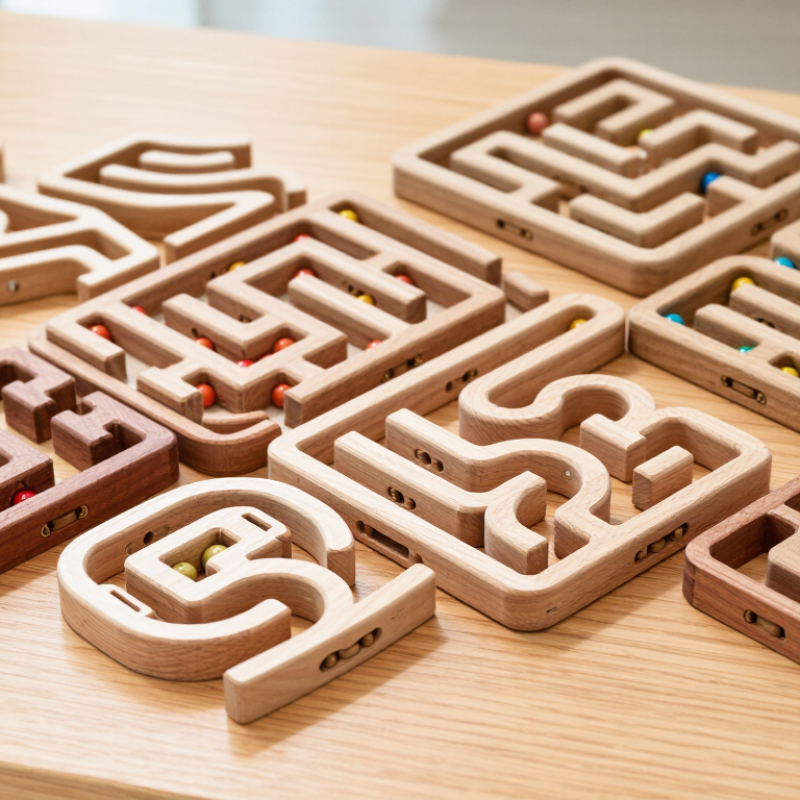
Wooden maze toys are usually flat boards with raised wooden walls and a bead or ball that moves through winding paths. A child guides it by tilting the board, turning knobs, or moving a small piece by hand. Each bend calls for a pause, a small adjustment, and sometimes a restart. Small turns matter. The toy makes cause and effect visible: tilt too far, and the bead may roll into a dead end.

A 2022 meta-analysis in Child Development reviewed 39 studies involving 3,893 children. Guided play showed modest advantages over direct instruction in early mathematics (effect size g=0.24), and larger advantages in shape knowledge (g=0.63) and task switching (g=0.40). These results concern guided play broadly, not wooden mazes specifically, so they should not be treated as proof that one toy produces the same gains. The American Academy of Pediatrics’ 2018 clinical report likewise describes play as supporting cognitive, language, and social-emotional development. During maze play, an adult can ask, “What happens if you tilt it left?” without steering every move. Yet some children may find a tight path frustrating. That is worth noticing, not dismissing.

Skills Children Can Develop Through Maze Play

A wooden maze gives children a hands-on way to practise fine motor control and hand-eye coordination. As they guide a bead through narrow paths, they learn to adjust pressure and slow down at tight corners. Their eyes follow the route while their fingers make small, careful movements. Each turn offers a simple cause-and-effect lesson. That matters.

Repeated play can build patience, focus, and early problem-solving skills. Children may pause, retrace a path, or try a different direction when the bead gets stuck. They also begin to notice shapes, distances, and how one route connects to another. A maze can bring frustration, too. That is not always a flaw; a challenge that feels too hard may need a break or an easier board. Adults can encourage children to describe their next move without solving the puzzle for them. Progress varies, and maze play is one useful activity, not a guarantee of specific skills.

Tips: Choose a maze suited to the child’s age and ability. Sit nearby, offer a hint when needed, and let the child control the bead. Short turns are fine; stopping is fine, too.

10 Best Wooden Maze Toys for Kids in 2026 - Skills Children Can Develop Through Maze Play

No. Wooden Maze Toy Type Best For Typical Age Guidance Skills Children Can Practice Play and Safety Notes
1 Bead-on-wire wooden maze Early hand exploration Often designed for toddlers; follow the toy’s age label Grasping, hand-eye coordination, visual tracking, cause and effect Choose securely fixed beads and a stable base. Supervise young children and check for loose parts.
2 Flat wooden rolling-ball maze Simple, hands-on problem-solving Commonly suited to preschoolers and older; check the label for small balls Patience, finger control, spatial awareness, planning Children tilt or guide the board to move the ball. Store loose balls safely away from children who may mouth them.
3 Magnetic wand maze board Practicing controlled movements Usually aimed at preschool or school-age children; follow product guidance Fine-motor control, concentration, visual-motor coordination, route planning The magnetic pieces are typically enclosed beneath a clear panel. Check that the panel and wand are intact before play.
4 Sliding-token maze Independent maze solving Often best for children who can follow a path and manage small pieces Logical thinking, persistence, attention, fine-motor skills Some designs use loose tokens. Check the age warning and keep pieces away from young children.
5 Two-sided wooden maze Varied play in one board Typically suited to preschoolers and school-age children Flexible thinking, visual scanning, coordination, problem-solving Different layouts can add variety. Look for smooth edges and a board that is easy for the child to hold.
6 Number-and-letter path maze Play with early learning concepts Often designed for preschool and early elementary ages Letter or number recognition, sequencing, concentration, hand control Learning content varies by design. Use it as a play prompt rather than a measure of a child’s ability.
7 Animal-themed wooden maze Storytelling and imaginative play Depends on the design and whether it includes small pieces Language practice, imagination, turn-taking, visual tracking Invite children to describe the route or invent a story. Check decorative pieces for secure attachment.
8 Multi-route wooden maze puzzle Children ready for a greater challenge Generally more appropriate for school-age children; check the maker’s guidance Forward planning, comparing options, persistence, spatial reasoning More routes can increase difficulty. Choose a challenge that allows the child to solve it without frequent frustration.
9 Wooden maze with movable gates Cause-and-effect exploration Usually better for children able to manage moving parts safely Reasoning, sequencing, experimentation, fine-motor coordination Moving parts should operate smoothly and remain securely attached. Adult supervision is appropriate for younger players.
10 Cooperative wooden maze game Playing and solving together Suitable when children can take turns and follow simple shared rules Communication, turn-taking, shared planning, patience Rules differ between games. For younger players, simplify the goal and let them collaborate at their own pace.

Age guidance is general because maze complexity and included parts vary. Always check the specific toy’s age label, inspect it for damage, and supervise play when appropriate.

Types and Key Features of Wooden Maze Toys

Wooden maze toys come in several forms. Flat finger-track boards suit younger children who guide a bead along a recessed path. Wire-track mazes add upright loops and sliding beads, while cube mazes offer routes on multiple sides. Tilt mazes ask children to move a ball by angling the board. That is harder than it looks. The best choice depends on the child’s grip, patience, and ability to follow a path, not just the toy’s age label.

Key features deserve a close look: smooth edges, securely fixed tracks, beads that cannot easily detach, and routes with enough space for small fingers. A stable base helps keep tabletop play from turning into a chase across the floor. The U.S. Consumer Product Safety Commission estimated 209,500 toy-related emergency department injuries in 2022; this figure covers toys broadly, not wooden mazes alone. It is a useful reminder to check construction and age guidance. A maze can still frustrate a child if its paths are cramped or the bead catches. One detail I would test in person is how smoothly it moves after repeated play. A polished surface may look neat, but it does not guarantee a well-made toy.

How to Choose a Safe, Age-Appropriate Maze Toy

Choosing a wooden maze starts with the child’s age, not the toy’s appearance. The U.S. Consumer Product Safety Commission estimated 231,700 toy-related emergency-room injuries in 2023; that figure covers toys broadly, not maze toys alone. It is a useful reminder to check labels and construction carefully. For children under three, avoid toys with small detachable beads or knobs that could fit in the CPSC’s small-parts test cylinder. Stay nearby during play.

Look for rounded edges, firmly attached pieces, and a smooth track with no splinters. Run a finger along the wood; rough spots matter. Check that the finish is intact and the maze remains stable when pushed on a flat table. A toddler may need a wide, simple path and large sliding pieces, while an older child may enjoy tighter turns and more steps. Follow the maker’s age guidance, but consider the child’s coordination and mouthing habits too. Age labels cannot capture every child. That part takes judgment. Recheck screws, joints, and chipped coatings over time, especially after drops or heavy play. A quick inspection is easy to skip, and I would not assume wooden means automatically safe.

Wooden Maze Toy Safety: Small-Parts Reference

A useful safety check when choosing an age-appropriate maze toy is whether any detachable piece could present a small-parts hazard.

The U.S. small-parts test cylinder is approximately 31.7 mm in diameter and 57.1 mm long. Parts that fit entirely inside it may pose a choking hazard to children under 3. This reference is not a substitute for checking the toy’s age label or applicable safety requirements.

Source: U.S. Consumer Product Safety Commission (CPSC), small-parts regulations.

10 Best Wooden Maze Toys for Kids in 2026

Choosing among the 10 best wooden maze toys for kids in 2026 starts with matching the challenge to the child. A preschooler may enjoy a wide, simple track, while an older child might prefer narrow turns and multiple routes. Look for smoothly finished wood, secure parts, and clear age guidance. A sturdy base matters, too; a maze that slides across the table can quickly lose its appeal.

Tips: Check the maze for rough edges before play. Set it on a level surface, and choose a ball large enough to suit the recommended age range. Small pieces can pose a choking risk for younger children, so supervise play when needed.

The best options make practice feel like play. Moving a bead or guiding a ball can support hand control, patience, and spatial reasoning. Some designs include bright colors or moving obstacles, but extra features are not always better. I’ve found that a child may return more often to a simple maze they can nearly master. That preference can change, of course. Compare the maze’s size, difficulty, and ease of storage, then pick one that fits your child’s attention span and play space.

Article Source: